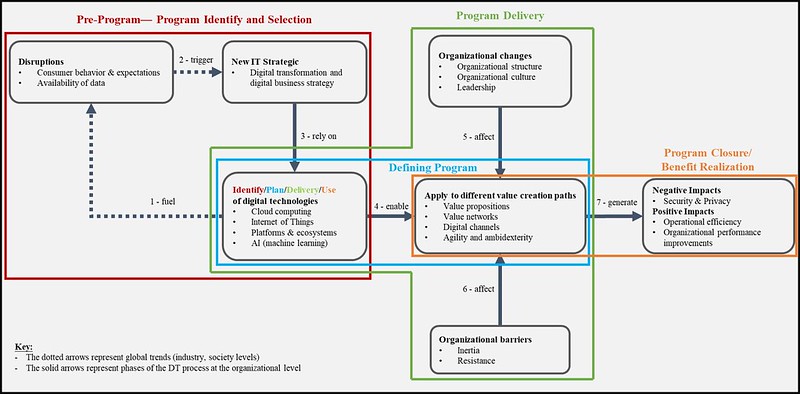
Digital transformation is important in today's business environment, bringing changes to society and industries through the use of digital technologies. Digital transformation is a process that triggers significant changes in physical attributes by combining information, computing, communication, and connectivity technologies, thereby improving the processes for targeted entities. As shown in the diagram below, the emergence of new digital technologies disrupts existing business environments and consumer behaviors, compelling enterprises to adopt new digital transformation and digital business strategies as responses. In digital strategies, enterprises decide on suitable new digital technologies, use these technologies to enable the enterprises, and open up new paths for value creation, thereby realizing the benefits of the enterprise's digital strategy.
A Program is a collection of multiple interdependent projects. Program Management involves the integrated management of multiple projects within an organization in a coordinated manner, aimed at achieving the program's strategic objectives at the organizational level. The management lifecycle of an IT program includes four phases: program identification, defining the program, program delivery, and program closure:
1. The identification phase begins after the IT strategic objectives of the enterprise are established, where an internal committee or senior leadership team assesses which IT activities should be initiated to achieve these IT strategic objectives.
2. The defining phase enters the planning stage of the IT program, which includes defining the desired outcomes of the IT program, its organizational structure, and assigning leaders for each IT project.
3. The core task of the delivery phase is the delivery of IT capabilities and the realization of benefits.
4. Finally, the closure phase involves evaluating the benefits realized, analyzing problems encountered in program management, and summarizing experiences. If the expected benefits are not realized, the option to continue with the same IT program or to analyze the reasons for failure and start a new IT program is available.
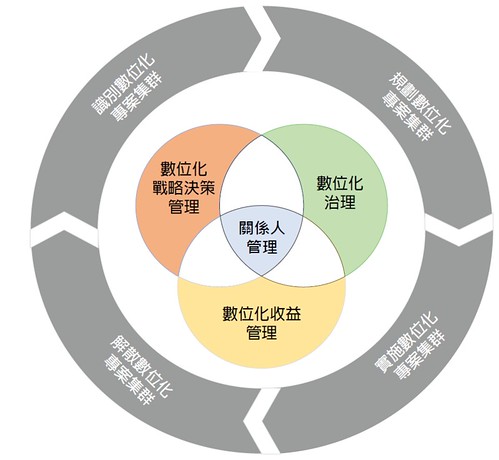
The diagram below is an example of the management lifecycle of a digital transformation program.
Digital transformation is essentially a topic of IT program management. IT program management can be applied at various stages of the digital transformation process. To realize the strategic objectives and expected benefits of an enterprise's digital transformation strategy, a series of projects such as training for employees' digital skills, digital infrastructure deployment, and digitalization for supply chain processes are planned. These projects are aimed at realizing the benefits of an enterprise's digital transformation program. IT program management can coordinate the management of multiple interdependent digital projects (such as digital strategy decision management, stakeholder management, digital benefits management, digital governance) to deliver integrated benefits that cannot be realized by managing single projects alone.
I am particularly interested in using IT program management to explain the problems and challenges faced by enterprises during the digital transformation process, to propose best practices for digital transformation, and to translate practical phenomena into theoretical frameworks that open up future research in IT program management theories.